Showing posts with label Kochi muziris biennale. Show all posts

Sunday, 23 December 2012

Sketching History of Indian Migration to Australia


The most down to earth artist one might come across in Fort Kochi as part of Kochi Muziris Biennale 2012 , Daniell Connell's sketches have become a talking point among the local crowd of Fort Kochi.

Daniel Connell is an Australian visual artist working in various locations globally. His work is in the context of an emerging movement of new collaborations concerned with allowing the advantages of the visual arts: analysis, self reflection and sensitivity  to be available to as broad a range of the wider community as possible and contribute to healthy and sustainable societies.


Daniel Connell's work for the Biennale is based on Indian migration to Australia stating that it is not a recent happening and have a history of over 60-80 thousand years. Mr. Connell portrays the two  individuals one from the past who has got Indian ancestry evident on his looks  and one from new generation both who are Indians migrated to Australia. These people seen in the portraits are Mr.Connell's friends in Australia. On the left is Justin Alan Mogridge from port Augusta, South Australia and on the right is Suresh Vasudevan from Kottayam, Kerala who migrated to Australia 5 years back.

Mr. Connell wants people to be aware that this migration is not a new thing and thus Indians should feel at home in Australia.
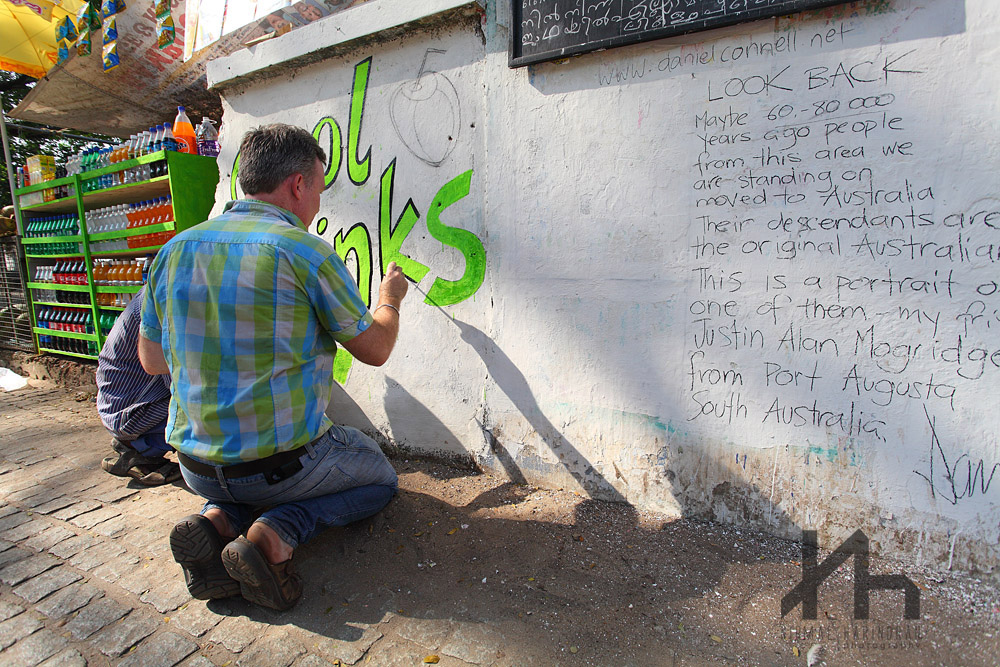


Daniel Connell painting for a nearby cool drinks vendor as the vendor approached requesting for a help. Shot on 12-12-12 in Fort Cochin, Kerala.

"My proposal began as a collateral project but was elevated to the main listing after it continued to consistently draw large local crowds and became a successful example of local engagement ameliorating some of the alienation that the new and strange thing called a Biennale can create.
I am extremely fortunate to be here and thank and congratulate the Biennale directors Bose Krishnacharya and Riyas Chomu for their personal support for the project." 


Daniel Connell sipping a tender coconut juice from the cool drinks shop for which he helped painting. On the background is Mr.Connell's assistant whom he recruited from Fort Cochin.


The public art work on Indian migration to Australia at one of the busiest spot near Fort Cochin beach.


Saturday, 22 December 2012

Remembering John . H . Aspinwall


The Aspinwall House being the heart of the ongoing Kochi Muziris Biennale (KMB) leaves no confusion for an enthusiast seeking the significance of Art Biennale in Kochi. 

Better explained here : http://kochimuzirisbiennale.org/concept/

For centuries, traders from Arabia, Egypt, Europe and China kept wandering around the coasts of Kerala searching for spices. Some of them made good business and left but some decided to stay and exploit further. John .H. Aspinwall was one such trades man who later carried forward the maritime tradition of Kochi and founded The Aspinwall and Company LTD in 1867. The company then became the center for spice trade from Kerala in the later half of 19th century following the legacy of spice trade that Muziris opened for the world.


A view from Aspinwall house ideally located near the port.


"The strange new music of the crying songs of the people we left behind mixing as your boat touches stone here as my new bones touch your bones."   
A text based installation by British artist Robert Montgomery as part of the Art Biennale facing the ferries in Aspinwall House.


Artist Subodh Gupta's installation during the process of creation in Aspinwall House.


 Artist Valsan Koorma Kolleri  working on his creation in Aspinwall House. Picture taken before the official day of starting of Biennale.


Art students and other enthusiasts volunteering to assist the artists a week prior to the start of the Biennale, painting history on the walls of Aspinwall House.


Visitors of Kochi Muziris Biennale enjoying a view of Kochi from the Aspinwall House's river facing building.


Most visitors experience a rediscovery of their concepts regarding contemporary  art and craft works. In picture a visitor walks through the dark corners on Aspinwall House looking out for the next creation to be seen in a building resembling a never ending canvas.


The poetic installation art lit up in broadway style light welcomes the seafarers and mariners back to land... back to Kochi.

Thursday, 20 December 2012

Kochi-Muziris Biennale (KMB)


“Kochi and Muziris were the two windows to the world through which trade, religions and culture came to the Indian sub-continent. Judaism, Christianity and Islam came to India through Muziris. Jainism and Buddhism flourished near the ancient trade center. Chinese and the Arabs had their colonies in both ports. The liberal and cosmopolitan outlook of the people was instrumental in the growth of these centers. We adopted Koch-Muziris as the central themes because of the universal outlook of the people and place,” Boney Thomas, research coordinator of the KMB Foundation said.


Two fisherman walks along side a public art work done by Australian artist Daniel Connell on the walls of an old building in Fort Cochin as Biennale Kick starts. Shot from fort cochin, kerala, on 12-12-12.


Old texts may have fired the imagination about the starting point of the Spice Route. The unfettered exchange of trade and culture opened the space to all religions. In different times in history, Chinese, Jews, Portuguese, Dutch and the British made Kochi their hub for trade. Pepper was as valuable as gold in the age of discovery.  In the 16th century, over half of Portugal’s state revenue came from West African gold and Indian pepper and other spices.  The proportion of the spices greatly outweighed the gold.


Visiting artists are using the lost port as a theme for the event. Many pieces will involve found art. A Kerala-born sculptor, is designing a piece with abandoned anchors, while Vivan artist Sundaram is creating a 400 square-foot reconstruction of Muziris using terracotta shards unearthed at the excavation site. He will both physically throw water on the installation, and incorporate video of flowing water, to represent the destruction of the city.


Following are few among the prominent works from the Biennale 


Chinese artist Zhang Enli's creation. A visitor peeps through the work at Aspinwall, Fort Cochin on December 15th, 2012.


 Artist Subodh Guptas work in Aspinwall building. Shot from Fort Cochin, Kerala on 15th December 2012.


An inspiring installation using roof tiles by Bangalore based artist, L N Tallur. Shot from Aspinwall building, Fort Cochin on 11th December, 2012.